small gods: Group Show featuring Trevor Coopersmith, Debra Disman, Nancy Evans, Lenny Gerard, Heng Yi, Tom Knechtel, Jenn Lima, Sandeep Mukherjee, Renée Pepion, and Julie Yeo


Our gods are small not because they are lesser, but because they are near, they are everywhere. They dwell in your and me, in bodies, in animals, plants, and spirits; in the earth beneath us and the air we breathe. Neither distant nor singular, the divine takes countless forms, appearing and disappearing in the ordinary fabric of existence. To encounter a god, perhaps, is not to look toward heaven, but to look again—
… among us.
October 31 – December 13, 2026
Opening Reception: Saturday, October 31, 4–8 PM
Curated by Ann Shi
Presented by a poco art, Los Angeles
LOS ANGELES, CA — Opening on Halloween, small gods: Desire, Devotion and the Making of Power brings together ten artists who challenge the boundaries between human and animal, divine and demonic, sacred and profane. Through hybrid bodies, unruly idols, playful monsters, and intimate shrines, the exhibition explores how desire, belief, and imagination transform ordinary beings into objects of worship or fear.
At the heart of small gods is the Buddhist concept of “相”: form, appearance, or the characteristics through which we perceive and distinguish things. In the Diamond Sutra, appearances are understood as provisional rather than permanent realities. The text introduces “一合相”, the apparent unity of composite phenomena: what seems to be a coherent whole is, in fact, a contingent gathering of interdependent parts. Even this unity, the sutra reminds us, must not be mistaken for an absolute truth.
Extending this proposition into the visual and material realm, small gods imagines the body itself as a composite being— human, animal, ghost, god, saints, and something yet unnamed. These hybrid creatures expose the instability of the boundaries themselves. An animal can become a deity, a toy, an object of worship; or a monster, an intimate self-portrait. What we call divine or demonic may reveal less about the being before us than about our own fears, desires, and systems of belief.
The exhibition questions the moral binaries through which religious and cultural traditions have shaped our understanding of good and evil, the sacred and the profane. Catholic iconography, Buddhist cosmology, Asian diasporic memory, queer fantasy, and popular mythology intersect, revealing how images of saints, demons, salvation, temptation, and enlightenment acquire cultural and spiritual authority. Yet these distinctions become unstable when holiness is mistaken for an image, goodness for an appearance, or spiritual attainment for an identity. The Buddhist concept of 著相, attachment to form and appearances, offers a particularly compelling paradox: even the pursuit of enlightenment can become another form of attachment when awakening is treated as something to possess, achieve, or embody. Our impulse to impose fixed identities and moral hierarchies becomes ironic when these forms of existences are inherently fluid, contradictory, and beyond our complete control.

Renée Peipion, Pobrecita (The Little Fish), 2025
These tensions unfold through the artists' distinct approaches to the body. Jenn Lima, Julie Yeo, and Renée Pepion give form to creatures and bodily configurations that resist conventional distinctions between beauty and grotesquerie, vulnerability and power. Lenny Gerard's Barbie works reveal the unsettling underside of idealized femininity, while Tom Knechtel's queer, anthropomorphic Hare transform animal imagery into a theater of desire, identification, and erotic fantasy. The body is neither a stable biological fact nor a pure spiritual vessel, but a mutable site where social expectations, private longings, and mythological projections converge.
Elsewhere, animals become vessels for human desire, fear, and spiritual projection. Nancy Evans's Phoenix / Rooster transforms a familiar animal into a mythological presence. Evoking the phoenix's associations with death and rebirth, the sculpture moves between earthly existence and spiritual transcendence. Its hybrid identity invites reflection on mortality and humanity's enduring desire to imagine life beyond its physical limits. What could be more sacred than confronting mortality itself?
Spirituality also emerges through abstraction and material transformation. Heng Yi's Buddhist pilgrimage imagery invokes traditions of devotion and transcendence, while Sandeep Mukherjee's Body Diagram dissolves the body's apparent boundaries into a continuous relationship with landscape, matter, and the cosmos. Moving between figuration and abstraction, their works propose that the self is porous, of shifting relationships, perceptions, and energies.
Extending beyond individual artworks, Debra Disman's intimate Womb shrine, located immediately after visitors enter through a narrow passage, creates a space for psychological refuge and contemplation. Trevor Coopersmith's site-specific Formidable Fungus installation transforms an opening in the attic into an altar, inviting visitors to experience the architecture itself as passage to the exterior, the encounters, and the light at the end of the tunnel.
Although Buddhist thought provides a conceptual point of departure, small gods refuses to confine spirituality—or Asia itself—to a single geography, religion, or visual tradition. Across Buddhist cosmology, Christian iconography, queer mythology, diasporic experience, and contemporary popular culture, the exhibition considers cultural identity as something continually assembled and transformed. Just as the body resists fixed boundaries, so too does the idea of Asia: not a region-defined exotic aesthetic, but an evolving constellation of encounters, migrations, and energy exchanges. Its cross-cultural and cross-media conversations resist the expectation that Asian art must be recognizable through symbols, materials, or traditions.
What happens when the monster looks familiar, the saint becomes vain, or the idol turns out to be a toy? Humor is essential to this inquiry. On Halloween, when the living dress as the dead and monsters walk among us, appearances become a communal game. small gods embraces this spirit of masquerade, absurdity, and transformation, allowing us to collectively question why some images inspire reverence while others provoke fear or ridicule. Let all existences be form- and appearance-fluid. After all, what isn’t made of carbon, of hydrogen, or the dusts that all are made of? How can a form point beyond itself without becoming the thing we cling to?

Trevor Coopersmith, Formidable Fungi, 2026
Site-specific installation for small gods
Our gods are small not because they are lesser, but because they are near, they are everywhere. They dwell in your and me, in bodies, in animals, plants, and spirits; in the earth beneath us and the air we breathe. Neither distant nor singular, the divine takes countless forms, appearing and disappearing in the ordinary fabric of existence. To encounter a god, perhaps, is not to look toward heaven, but to look again—
… among us.
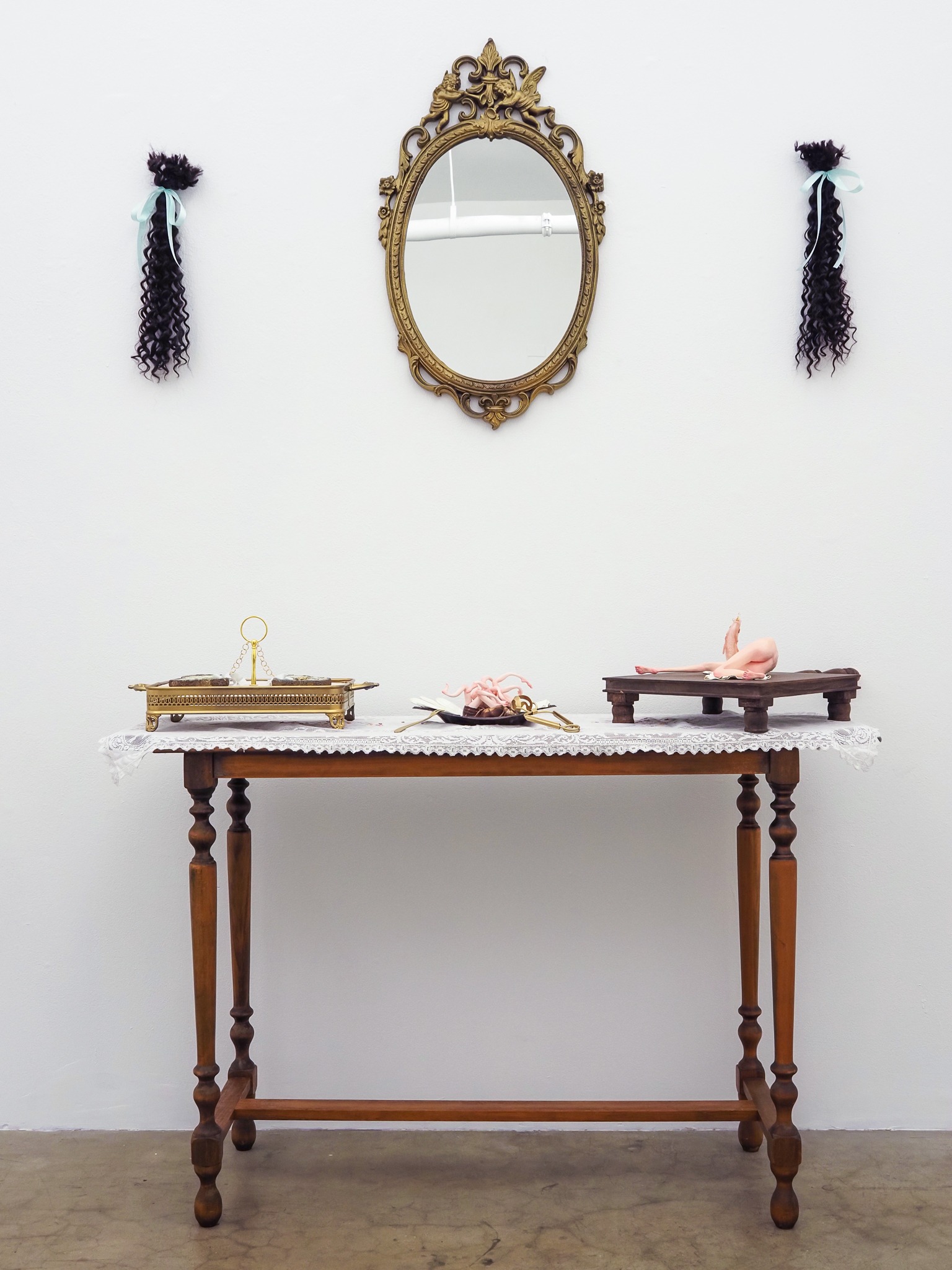
Renée Pepion, “The Altar”


